
How does Polyurethane Foam Lifting work effectively?

September 13, 2024
Have you ever noticed crooked driveways or uneven surfaces around your home? These issues can be more than unappealing and create a domino effect for other parts of its construction. Sinking concrete or gaps under concrete slabs can lead to severe structural damage, and safety hazards, and decrease the property value. Providentially, an innovative solution that effectively addresses these issues with polyurethane foam lifting. This blog will provide a deep exploration of how this modern method works, its benefits, and why it’s a smart choice for homeowners and businesses alike. If you’re looking for experts to help repair the concrete in your basement, or driveway, contact the professionals at STL Polyjack today for our Polyurethane Foam Lifting services!

Understanding Concrete Settlement

Concrete settlement can occur for various reasons, especially soil erosion, water leakage, and natural ground shifting. When concrete settles, the foundation of the structure is at risk. Identifying such things in the earlier stage can fix the issue, saving you thousands of dollars.

Signs of Concrete Settlement to Watch for in St. Louis,

  • The initial signs visible are cracks. Hairline cracks are non-hazardous, but it’s better to have a closer look at them whether it is vertical or horizontal on the wall.
  • Following the cracks, the problem gets evaluated as uneven or sloping floors. Usually, it doesn’t take much of a sloping floor to indicate a problem with the foundation. As soon as you notice sloping, it’s time to contact us about possible foundation repairs.
  • Additionally, Pooling water confirms the settlement issue and will cause more damage to the concrete. If you see water can’t drain the way it should, you must inspect the concrete for problems.

The Resulting Dilemma

Ignoring the signs of concrete settlement can lead to significant issues. Apart from the structural integrity, it can also create safety hazards. Over time, these issues can reduce your property value, as potential buyers or tenants may be deterred by the visible signs of neglect or the potential for costly repairs.

What is Polyurethane Foam Lifting?

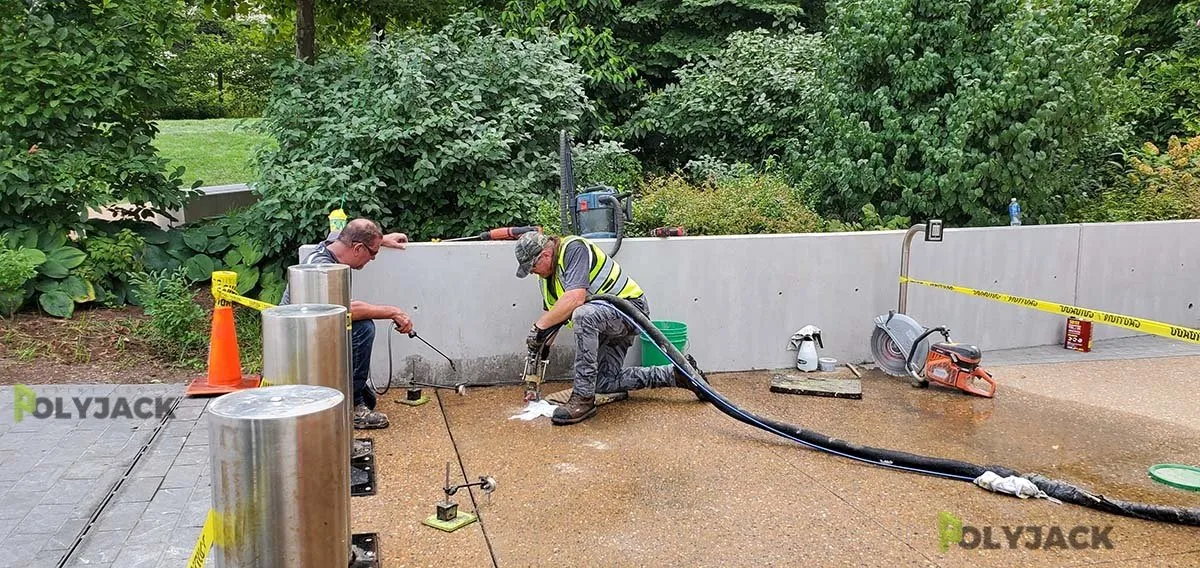
Polyurethane foam lifting, or foam jacking, is a modern technique to repair sinking concrete. This method involves injecting high-density polyurethane foam beneath the concrete slab. As the foam expands, it fills voids and lifts the concrete back to its original position. It provides a quick and cost-effective solution for uneven concrete surfaces.

Benefits of Polyjacking

Cost-effective: Polyjacking is more affordable compared to extensive repairs or replacement.

Durable: Once cured, polyurethane foam is designed to withstand the test of time, providing an enduring fix for your concrete issues.

Minimal Disruption: The process requires smaller holes for injection and the foam settles within a few minutes, allowing for immediate use of the area.

The Process of Polyurethane Foam Lifting

Step 1: Inspection and Assessment

Before the work begins, professionals will conduct a thorough inspection of the affected area. They will assess the extent of the settlement, identify the underlying causes, and develop a lifting plan. This assessment is crucial for determining the best approach to restore your concrete.

Step 2: Drilling Small Holes

Once the assessment is complete, small holes (⅜ on an inch) are drilled into the concrete slab. These access points allow the foam to be injected directly beneath the surface without causing significant damage to the surrounding area.

Step 3: Injecting the Foam

Next, the high-density polyurethane foam is injected through the drilled holes. As the foam is introduced, it begins to expand and fill any voids beneath the slab. This expansion is carefully controlled to ensure that the concrete is lifted evenly and smoothly without causing damage to the surrounding structures.

Step 4: Monitoring and Final Adjustments

As the foam expands and lifts the concrete, professionals closely monitor the process. They make any necessary adjustments to ensure that the lifting is even and that the concrete returns to its original position. This careful monitoring helps avoid over-lifting or under-lifting, which could lead to further issues down the line.

Step 5: Sealing the Holes

Once the lifting is done, the small holes are sealed with a durable patching. This final step leaves the area looking clean and minimizes the visual impact of the repair. You can immediately use the area after the process is done, as the foam cures quickly.

How Does It Work? The Science Behind Polyurethane Foam

Polyurethane foam’s magic lies in its chemical properties. After injection, the foam undergoes a chemical reaction that causes it to expand. Polyurethane foam is created through the reaction between polyol (an organic compound containing multiple hydroxyl groups) and di-isocyanate or polymeric isocyanate, in the presence of catalysts, such as metallic or amine which can influence the foam’s cell structure, rigidity, rise time and overall consistency. The most common catalyst used for polyurethane foam lifting is Triethylenediamine (TEDA), often referred to as DABCO.

Due to its high durability and flexibility, polyurethane foam is also environmentally friendly. The materials used are often made from recycled or renewable resources, and the lifting process reduces waste by preserving existing concrete rather than requiring a full replacement.

Conclusion

As a Top Concrete Repair Company in St. Louis, we offers a superior solution for concrete repair, combining efficiency, cost-effectiveness, and durability. It’s a minimally invasive process that provides quick, long-lasting results, making it the smart choice for both homeowners and businesses facing concrete settlement issues. If you’re dealing with any of the foundation issues or encountered any signs mentioned on this blog, don’t delay until the problem worsens.

Contact us today for a free estimate and learn more about how polyurethane foam lifting can restore your concrete to its original condition. Our expert team is here to provide a reliable and effective solution tailored to your requirements. Don’t let sinking concrete compromise your asset!